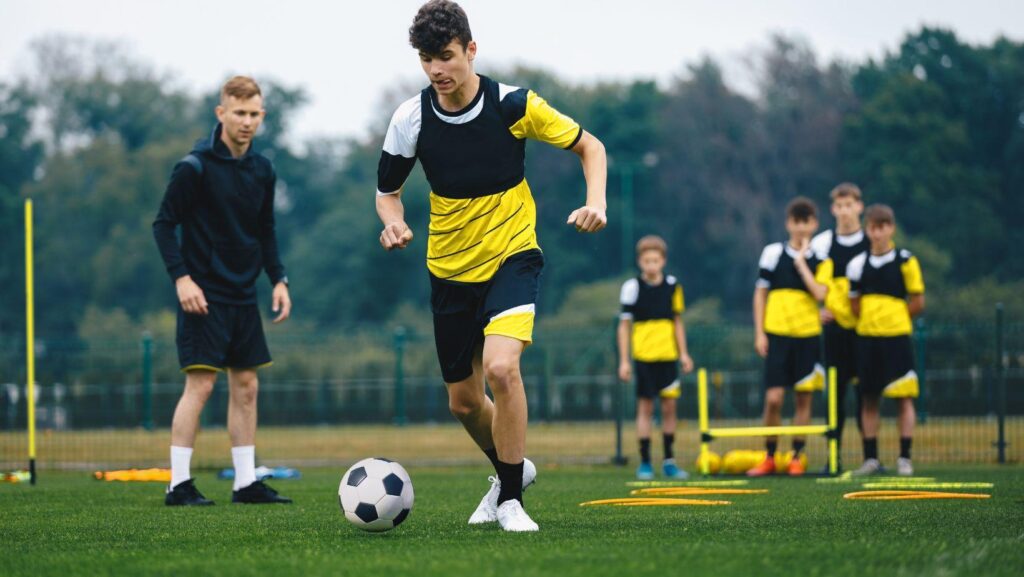
Twenty years ago a fitness coach judged a session by watching it. Notes went into a paper diary, and decisions about intensity rested on experience. That judgement still matters, but now sits alongside thousands of data points collected at every session.
The shift reached far beyond elite European clubs. GPS vests, automated video analysis and predictive models are used in second divisions, youth academies and semi-professional setups, largely because the hardware became far cheaper.
Much of this information eventually reaches supporters. Sports media platforms and statistics portals, among them париматч, publish performance metrics that were once confined to internal reports.
What a tracking vest actually records
The unit sitting between a player’s shoulder blades combines satellite positioning with motion sensors. That pairing produces four groups of information:
- Distance and speed zones. Total ground covered, split by intensity rather than reported as a single figure.
- Accelerations and decelerations. Changes of pace, which drain players faster than steady running.
- Directional changes. Turns and cuts that place particular stress on knees and ankles.
- Session load. A composite score used to compare one training week against another.
Internal load versus external load
Practitioners separate what a player did from what it cost them physiologically. The distinction explains why two athletes running identical distances may need different recovery:
|
Concept |
How it is measured |
Why it matters |
|
External load |
GPS distance, sprints, accelerations |
Describes the work performed |
|
Internal load |
Heart rate, perceived exertion |
Describes the strain experienced |
|
Recovery status |
Sleep and subjective wellness scores |
Indicates readiness for the next session |
A common misreading: high total distance is often quoted as evidence of effort, yet it says little on its own. A midfielder jogging through a match can cover more ground than a winger producing repeated sprints at far greater physiological cost.
Sleep, wellness and the limits of monitoring
Recovery tracking expanded quickly through wearable rings and wristbands. The drawbacks are equally clear: consumer devices vary in accuracy, and constant measurement can leave athletes anxious about numbers they cannot control. Several clubs now limit how much of this data players see.
Where artificial intelligence contributes
Machine learning handles the tasks humans find tedious. Software tags match events, groups tactical patterns and flags deviations from a player’s normal profile. What it does not do is decide anything: staff interpret the output against the calendar, the opponent and the squad’s condition.
On injury prediction: vendors market these systems as injury prevention tools, yet the evidence is weaker than the marketing suggests. Load monitoring highlights unusual spikes, but no model forecasts a specific injury, and several widely used load ratios have been criticised in sports science literature.
From professional squads to amateur players
The same technology filtered down to recreational sport in simplified form. Consumer watches, heart rate straps and phone apps now record much of what elite systems captured a decade ago. The gap is no longer the sensor but the interpretation: a club employs physiotherapists and analysts, whereas an amateur runner is left alone with a dashboard.
How to check performance data independently
Public sources cover a surprising amount. Flashscore and Sofascore publish minutes and individual match metrics, Transfermarkt documents injury histories, and Oddsportal tracks how betting odds moved around team news. Comparing sources prevents conclusions drawn from a single fixture.
Frequently asked questions
Do smaller clubs use this technology?
Increasingly yes. Entry-level GPS systems are affordable for academies and lower-division teams, though staffing to analyse the output remains the bigger obstacle.
Is football ahead of other sports?
Not particularly. Cycling worked with power meters for decades, and North American leagues including the Canadian Football League adopted contact and load monitoring early.
Can fans see this data?
Only partially. Clubs publish selected figures, while raw training data remains private and commercially sensitive.
What technology has not changed
Measurement improved dramatically; judgement did not become automatic. The numbers describe what happened, yet someone still decides whether a tired defender starts on Saturday. Clubs that benefit most treat data as one voice in the conversation rather than the final word.