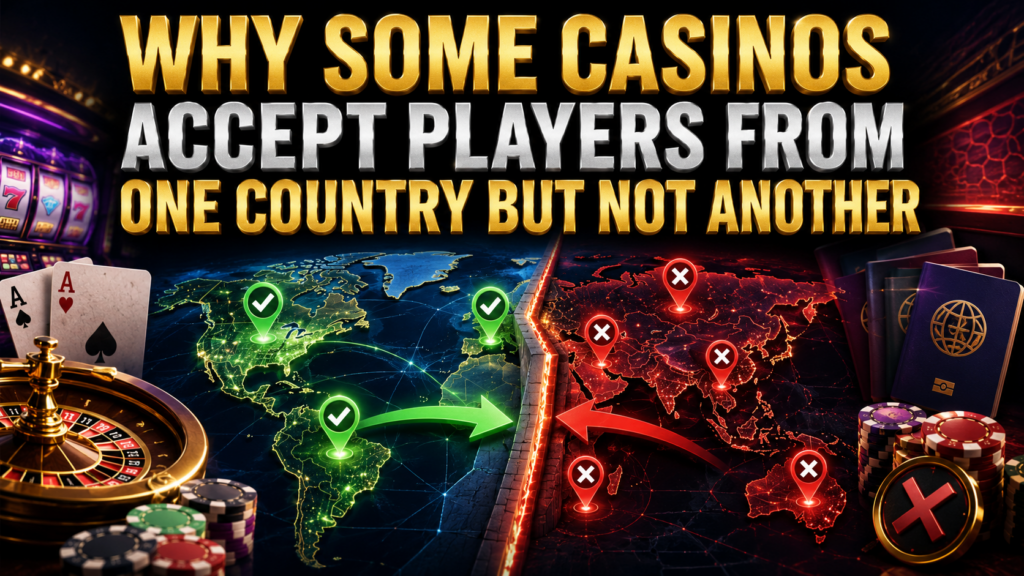
Two people can open the same online casino site on the same evening and see completely different pages. One gets a full lobby with hundreds of slots. The other sees a polite message: service not available in your region. The difference rarely has anything to do with the player. It comes down to licensing, tax rules, payment corridors, and commercial choices made long before anyone clicked register.
The License Decides the Map
Every regulated online casino operates under one or more licenses issued by a specific jurisdiction. That license defines which countries the operator is allowed to serve, what games it may offer, how it must handle player funds, and which advertising rules apply. A Malta Gaming Authority license, for example, covers a wide set of European markets but excludes territories where local law reserves online gambling for a national operator.
Some regulators grant a broad international remit; others are strictly national. A casino licensed in Sweden can serve Swedish residents through the SGA framework, but the same brand may need a separate UK Gambling Commission license to accept players in Britain, and yet another to operate in Ontario.
Local Law Overrides Everything
Even when an operator holds a license that theoretically permits cross-border service, local legislation in the player’s country can block access. National frameworks fall roughly into three camps:
- Monopoly markets: Only a state-owned or state-licensed operator may offer online games. Foreign casinos are blocked at the payment or DNS level.
- Licensed open markets: Private operators can apply for a local permit and compete under strict rules on tax, advertising, and responsible play.
- Prohibited markets: Online gambling is illegal for both operators and, in some cases, players. Casinos geoblock these regions to avoid legal exposure.
Operators keep a country blocklist that reflects this patchwork. The list changes as laws change; a market that was grey last year may be fully regulated this year, or vice versa.
Editorial guides such as Clash of Slots often note which studios and operators sit under which regulators, which explains why a slot from one provider appears in a Finnish lobby but is missing from a German one.
Payments, Currencies, and Practical Friction
Licensing is only half the story. Payment infrastructure decides whether serving a country is actually worth it. If local banks routinely reject gambling-coded transactions, or if the dominant e-wallet refuses casino merchants, the operator faces high failure rates on deposits and slow, expensive withdrawals. Some smaller markets are simply not commercially viable, even when legally permitted.
Currency support, KYC document formats, and local identity verification systems add further friction. A casino that has integrated with BankID in Scandinavia may have no equivalent solution for Latin America, and building one for a small user base rarely pays off.
Bonus Rules and Game Availability
Country restrictions do not stop at the front door. Inside the lobby, individual games and bonuses can be region-locked. A provider’s licensing deal with a specific studio may exclude certain territories, or a title’s music and imagery may fall foul of local content rules. That is why two players on the same casino, in neighbouring countries, can see different game grids and different welcome offers.
How to Read the Signals as a Player
Before spending time on registration, a few checks save frustration:
- Look for the license badge in the footer and confirm the regulator on the regulator’s own register.
- Check the terms and conditions for the list of restricted countries.
- Confirm that your preferred payment method is listed for your country, not just globally.
- Note the supported currencies—a missing local currency often signals limited support.
- Read the responsible gambling section; serious operators localize tools and helpline links.
For readers who want a broader view of how regulation shapes consumer choice, the UK Gambling Commission publishes plain-language explainers on licensing conditions, and the European Union Drugs Agency hosts research on behavioural aspects of gambling across member states. Both are useful reference points that sit outside the commercial side of the industry.
Why This Matters Beyond Gambling
A structured approach makes complex decisions easier. Whether someone is evaluating budget planning software or comparing online services, the process is similar: review the details, compare the options, and understand the rules before committing.
Taking a few extra minutes to read the terms, check eligibility requirements, and understand how a product works reduces the chance of unexpected surprises later. The same habit of comparing information carefully is valuable regardless of the type of service or product you are considering.
The Short Answer

A casino accepts players from one country and not another because a licence permits it there, local law allows it, payments work reliably, and the numbers add up. Remove any one of those pillars and the door closes, regardless of how the site looks from the outside. Understanding that chain turns a confusing rejection into a predictable one, and helps players choose venues that are actually built to serve them.